

Author’s note: This is the first in a multi-part series about Edmund G. Ross, who served as a Senator for Kansas in the U.S. Congress from 1866-1871. I plan to publish a new part each day during the July 4th weekend marking America’s 250th birthday. I hope you’ll take the time to read each part of this important story about our state’s history - and share it with others. I think it’s an important story that speaks to our own moment in our nation’s future history.
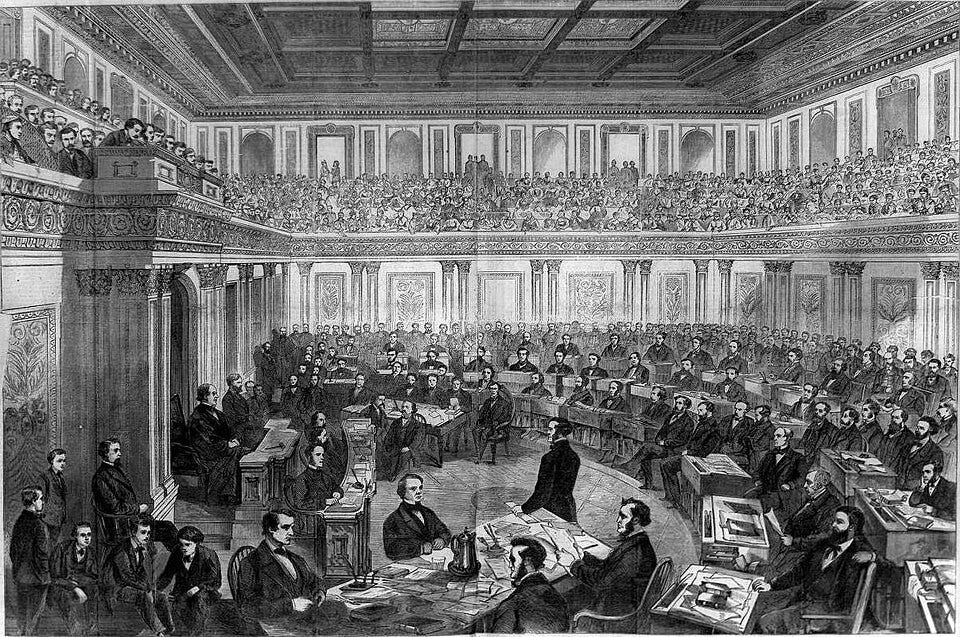
The Trial
The House articles of Impeachment against President Andrew Johnson advanced from the House with a vote of 126 to 47. A trial was later set in the Senate.
Up to this point, Ross is a well respected member of the free state movement - a strong Republican who held the passionate views of equality under the law, and the preservation of the Union. His constituency, however, was more radical, with people who hoped to see the South harshly punished for its rebellion.
The editor of Kansas State Record - a paper once owned by Ross - expressed grave concern that the junior Senator from Kansas had lost his zeal, influenced by his former commander Thomas Ewing who had been a contender for Johnson’s cabinet, and with whom Ross had a good relationship.
Indeed, Ross’s view was moderating, as this excerpt detailed in the book Edmund G. Ross:
“To Ross’s credit, he had an open mind and was not adverse to change…Ross was not a politician who simply followed the dictates of the party leaders. As time went on, Ross would find that he could not reconcile party loyalty with sound reasoning, and it would frustrate him as nothing else ever had.”
During the Senate Impeachment Trial, there was an expectation that every Democrat would vote to acquit Johnson and every Republican would vote for conviction. There was a group of Republicans who made it known that they considered voting to acquit, and they were “relentlessly stalked and warned that their future was grim if they didn’t vote to convict.”
It seems some things never change.
Ross kept his leanings to himself, though that worried his fellow Republicans, including the Senior Senator from Kansas, Samuel Pomeroy - who had greeted Ross when he first arrived in Kansas with his family and a band of dedicated abolitionists.
Some of the arguments in the trial sound very familiar to some of the arguments we hear today. There was conflict between Constitutional powers granted to Congress and those granted to the President, and that was at the heart of the impeachment trial.
The prosecution, led by Lincoln ally Thaddeus Stephens, argued that Johnson had openly violated his oath of office.
“When Andrew Johnson took upon himself the duties of this high office he swore to obey the Constitution and take care that the laws be faithfully executed. That, indeed, has always been the chief duty of the President of the United States. The duties of legislation and adjudicating the laws of his country fall in no way to his lot.”
Johnson’s defense, however, argued that the Constitution didn’t provide any mechanism to settle disagreements about the legality of those laws - except to violate them and involve the Supreme Court. He stated that the President has as much authority to question the constitutionality of a law as Congress did to enact it.
“The President is not a ministerial office. His function is not merely to execute laws, but to construe them as well…When, therefore, this tenure-of-office act came to be considered by the President in reference to his purpose to remove Mr. Stanton from office, he had a right and it was his duty to decide for himself whether the proposed removal of Mr. Stanton was or was not forbidden by the act. As yet that act had received no construction by the judicial department, nor had the President any authority to send the act to the Supreme Court, and require the judgement of the court upon its true meaning. The Constitution gave him no right to resort to the judges for advice.”
During the preliminary hearings on Johnson’s trial, Ross had voted in most instances to allow all evidence and arguments from both the defense and prosecution into the record. That wasn’t the case with some of his colleagues - but it’s an important distinction. Ross believed that the evidence ought to be seen and heard, and that it was unfair to build a case in such a heavy trial without allowing the President to freely present his arguments and evidence.
The Vote
Pressure intensified on Ross ahead of the impeachment vote on May 16, 1868.
On May 14, Ross and Pomeroy received a telegraph from Daniel R. Anthony, who claimed to represent “1,000 others” and said “Kansas has heard the evidence and demands the conviction of the President.”
At midnight before the day of the vote, one Senator beat on the Ream family home, where Ross rented a room. He stayed until 4 a.m., demanding to see the absent Ross and tormenting Vinnie, a teenage girl who lived there, with accusations that she was hiding him.
On the morning of May 16, Thaddeus Stephens and Samuel Pomeroy met Ross as he entered the Senate chambers. Pomeroy warned Ross that a vote for acquittal would see his political death and that bribery and corruption charges against him would come forthwith.
Ross also faced his physical death - having received a number of assassination threats, as well as a plot to kidnap him.
If seven Senators voted for acquittal the case against Johnson would fail. When the question came to Ross, the six known dissenters from the Republican party had already voted for acquittal.
In that moment, Ross had a profound choice to make. He could go along with the demands of his party and make an easy choice for his future. Or he could do what he believed to be right, the more difficult path.
“Conscious that I was at that moment the focus of all eyes, and conscious also of the far-reaching effect, especially upon myself, of the vote I was about to give, it is something more than a simile to say that I almost literally looked down into my open grave. Friends, position, fortune, everything that makes life desirable to an ambitious man were about to be swept away by the breath of my mouth, perhaps forever.”
Ross was the seventh Republican vote for acquittal. It was the vote that spared Andrew Johnson’s presidency.
Near the end of May 1868, Ross spoke in the Senate about the reason for his vote. It is a timely warning that we seemingly have forgotten in many ways.
“To deliberately trample upon law and established forms was the only way in which impeachment could have been carried as a party measure, and that no party, however strong, can afford to do. When we depart from those forms of law by which we seek the ends of justice we at once inaugurate confusion and anarchy, and we substantially do that when we subordinate the issue of a trial, largely judicial in its nature, to the behests of party will.”
The Fallout
Immediately after the vote, Pomeroy followed up on his previous threats. He promised Ross that every sliver of his life would be exposed and exploited unless “he redeemed himself of his corrupt apostasy, a chain of circumstantial evidence would be fastened about him.”
Immediately after the verdict, the House authorized an investigation into whether corruption had influenced the Senators who voted for acquittal.
Ross explained his vote in later speeches and in a book he published 30 years later. He felt removing the President without real cause would both weaken the office long into the future, and, since Johnson was a Southern, reignite the flames of rebellion.
Ross was accused of corruption and bribery, and faced an investigation and immense harm to his reputation. A newspaper editorial in the Leavenworth Conservative wrote:
“It was left to the State whose noblest citizen was John Brown, the State whose soil is hallowed all over with the blood of men, women, and children, the State which has only four words on its banner ‘Equal Rights for All’ to be betrayed and outraged by this creature Ross. He is dead - dead to honor, dead to liberty, dead to Kansas.”
Such thoughts were repeated throughout the Kansas Press.
Ross even received a telegram directly from Kansas Supreme Court justice L.D. Bailey:
“Probably the rope with which Judas hanged himself is lost, but the pistol with which Jim Lane (whom Ross replaced in the Senate) committed suicide is at your service.”
Naturally, the attention on Ross’s vote and reputation affected his family. They wrote to reassure Ross, and he did the same for them.
Shortly after the vote, Ross wrote a letter to his wife, Fannie.
“Don’t be discouraged, dear wife, it’s all coming out all right. This storm of passion will soon pass away, and the people, the whole people, will thank and bless me for having saved the country by my single vote from the greatest peril through which it has ever passed, though none but God can ever know the struggle it has cost me. Millions of men are cursing me today, but they will bless me tomorrow. But few knew of the precipice upon which we all stood on Saturday morning last.”
Ross never completely shook the harm to his reputation, his standing did improve over time. (While Ruddy’s book tends to paint Ross in a positive light, another historian, David O. Stewart, argued in his book “Impeached: The Trial of President Andrew Johnson and the Fight for Lincoln’s Legacy” that Ross’s political patronage connection to wealthy Kansas trader, and eventual white collar criminal, Perry Fuller was too strong to ignore.)
He lost his re-election bid in 1871, and left the Republican Party in 1872. He ran as a Democrat for Kansas governor in 1880, before moving to Albuquerque, New Mexico in 1882. He served as territorial governor of New Mexico from 1885 to 1889, where he reportedly served with respect and honor.
John F. Kennedy’s Profiles in Courage best explains the latter years of Ross’s life.
Just before his death, Congress granted Ross a special pension for his service to the country during, and after, the Civil War. The newspapers that once called for his public haranguing now recalled him more softly, praising him for his stand against “legislative mob rule.”
‘“By the firmness and courage of Senator Ross,” it was said, ‘the country was saved from calamity greater than war, while it consigned him to a political martyrdom, the most cruel in our history...Ross was the victim of a wild flame of intolerance which swept everything before it. He did his duty knowing that it meant his political death...It was a brave thing for Ross to do, but Ross did it. He acted for his conscience and with a lofty patriotism, regardless of what he knew must be the ruinous consequences to himself. He acted right.”
Interesting articles. Senator Ross seems honorable and even admirable for the stance he took which, as far as I can tell, was honest to his conscience and perhaps prescient of very dire consequences had he voted otherwise. If he foresaw the danger of voting to remove President Johnson on what he determined insufficient grounds for so serious an action, then how can he be judged too harshly by history for doing so?