
Part 2: A Kansas Kind of Courage
Unity helped end the war, but lingering divisions fueled a Constitutional Crisis

Author’s note: This is the first in a multi-part series about Edmund G. Ross, who served as a Senator for Kansas in the U.S. Congress from 1866-1871. I plan to publish a new part each day during the July 4th weekend marking America’s 250th birthday. I hope you’ll take the time to read each part of this important story about our state’s history - and share it with others. I think it’s an important story that speaks to our own moment in our nation’s future history.
Southern Democrat of Tennessee, Andrew Johnson, became President after Abraham Lincoln’s assassination on April, 14, 1865.
The combining of a Republican and Democrat onto a single Unity ticket was something Lincoln wanted - as did the conventioneers who made the selection of Johnson as Vice President at the Baltimore Convention in 1864.
The arrangement, as explained in Richard Ruddy’s book on Edmund Ross:
“Mr. Lincoln had been elected President in 1860, distinctively as a Republican. In 1864, however, the conditions had changed. The war had been in progress some three years, during which the insurgents had illustrated a measure of courage, endurance, and a command of the energies of successful warfare that had not been anticipated by the people of the North. It was seen that to insure the success of the Union cause it was imperative that there should be thorough unity and cooperation of the loyal people of all parties--that it was no time for partisan division among those who hoped ever to see a restored Republic--that it was necessary to lay aside, as far as possible, mere partisan issues, and to unite, in the then approaching campaign, upon a non-partisan, distinctively Union ticket and platform.”
The Convention advanced Johnson’s nomination, and outlined the platform of the National Unity Party - using the first three resolutions to send a message that this ticket was about bringing the Union together. Partisan politics, for a moment, had faded behind the existential threat to our Nation.
“Resolved, 1st. That it is the highest duty of every American citizen to maintain against all their enemies the integrity of the Union and the paramount authority of the Constitution and laws of the United States; and that laying aside ALL DIFFERENCES OF POLITICAL OPINION, we pledge ourselves as Union men, animated by a common sentiment and aiming at a common object, to do everything in our power to aid the Government in quelling by force of arms the rebellion now raging against its authority, and in bringing to the punishment due to their crimes the rebels and traitors arrayed against it.”
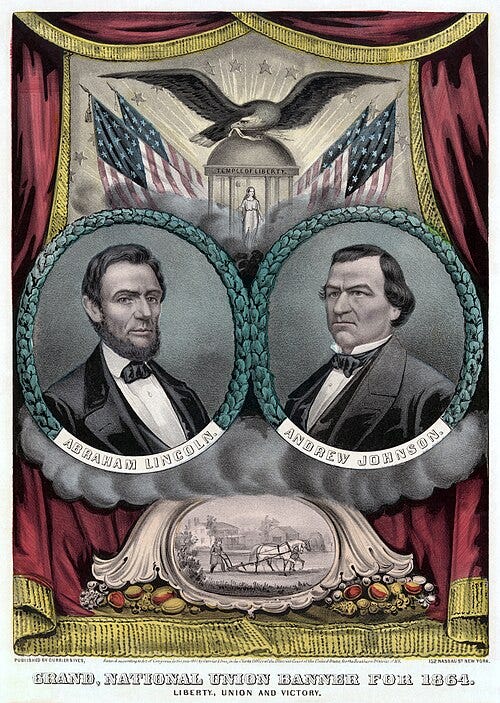
That sense of unity began to fade, however, when Johnson ascended to the presidency.
While Johnson believed in saving the union, he was an “old-fashioned Southern Jacksonian Democrat” who favored the view of state’s rights to do largely as they please. And he was a southerner of the times - racist, and strongly opposed to the idea of equality for the recently freed slaves.
“This is a country for white men, and by God, as long as I am President, it shall be a government for white men,” Johnson wrote in 1866.
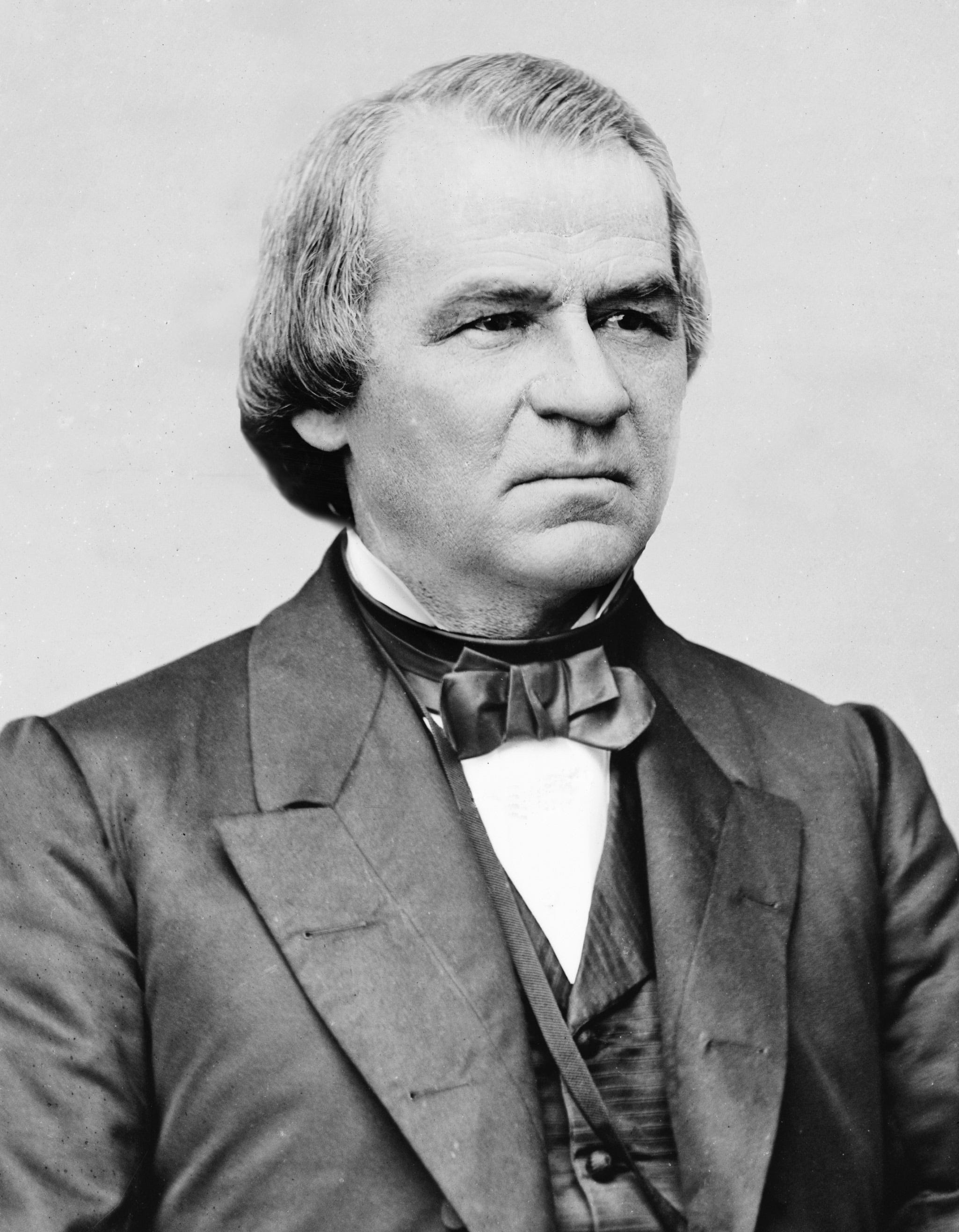
But he supported an end to slavery and never called for Southern Secession. As a Senator from Tennessee he retained his seat even as his state left the union. The North viewed his act as heroic; the South viewed him as a traitor.
With the war over, and Lincoln in the grave, Johnson quickly went to work on his version of reconstruction while Congress was in recess.
He handed out thousands of pardons to southern rebels, so long as they’d take a loyalty oath to the Union. Men of wealth and position, however, had to secure a special pardon directly from the President. He allowed southern states to set up “black codes” that effectively permitted continued slavery under a different name. Johnson even appointed provisional governors throughout the south who are tasked with implementing his reconstruction plan.
Congress returned in 1866, livid to see so many rebel leaders still in positions of authority, feeling that these men must be punished for their crimes - not rewarded. They took swift action to limit Johnson’s powers - passing an extension of the Freedmen’s Bureau which worked to assist freed slaves (and poor white families) who had been displaced after the war, the Civil Rights Act of 1866, and the 14th Amendment to the Constitution - granting full rights to anyone born in the United States, which was just upheld by the Supreme Court in June 2026.
Johnson vetoed the Freedmen’s legislation and the Civil Rights Act, but Congress, for the first time in American History, overrode a presidential veto on meaningful legislation.
The Radical Republicans in Congress further restricted Johnson by passing a number of measures designed to limit Presidential power, including the Tenure of Office Act - which outlined that any federal official confirmed by the Senate couldn’t be removed from office without the consent of the Senate.
Johnson was incensed and vetoed what he viewed as unreasonable restrictions on his administration. Congress again overrode the president’s veto - setting up the stage for Johnson’s eventual impeachment trial and Edmund Ross’ pivotal role in History.
In the summer 1867, Johnson decided to replace Secretary of War Edwin Stanton, whom Johnson believed had conspired with Radical Republicans to undermine his reconstruction efforts and his administration. Johnson replaced Stanton with Civil War hero Ulysses S. Grant.
Congress returned in January 1868, and refused Stanton’s removal. In turn, Johnson refused to accept the Senate’s refusal. He appointed Lorenzo Thomas as acting secretary, thus avoiding Senate approval.
Impeachment proceedings began in a few days’ time.
Though the impeachment articles built a case around Johnson’s violation of the law, time and reflection has revealed that Johnson’s trial was rooted more in politics than in legitimate Constitutional claims. The Tenure of Office Act was so onerous that in 1887 Grover Cleveland successfully lobbied for repeal of the law, and in 1926 the Supreme Court ruled it unconstitutional to require Senate approval for removal of certain officials.
By May of 1868, Edmund Ross would find himself tasked with casting his vote on the matter, fully aware of the heavy consequences it carried. In 1957, then Senator John F. Kennedy spoke about Ross during the University of Kansas Convocation.
“I feel a great sense of privilege and responsibility in appearing in this State – for this is the home of a great United States Senator of the past who has long been an inspiration to me and who consequently played a major role in my book, Profiles in Courage,” Kennedy said. “I refer, of course, to one of this state’s earliest Senators some ninety years ago, the man who performed…“the most heroic act in American history,” and who for a time made his home in this city. His name – which I shall never forget – is, of course, Edmund G. Ross.
Coming soon - Part 3: Ross pressured within and without to toe the party line.