
When Truth isn't good enough to win...
Political insiders take to redirecting voters about Judicial selection vote in August

If you put “Kansas Judicial Selection” or “Kansas Amendment Vote” into Google, the top, paid-for result is from an Website called the Kansas Information Network.
Follow the link, and you’ll land on a site that declares that it exists to provide “Facts on Kansas’s Top Topics.”
Click on the “About” page, and you’ll see this
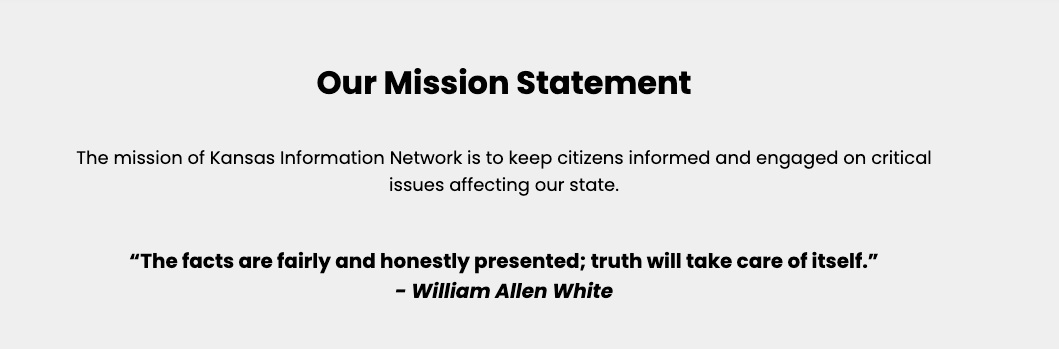
The site claims to be a fair and neutral examination of the Kansas Constitutional Amendment Vote that you’lll be asked to vote on August 4.
Some reasonably well-respected Republican lawmakers promoted the site as the “the best I’ve found so far” for an “unbiased source, side-by-side” comparison” on the issue.
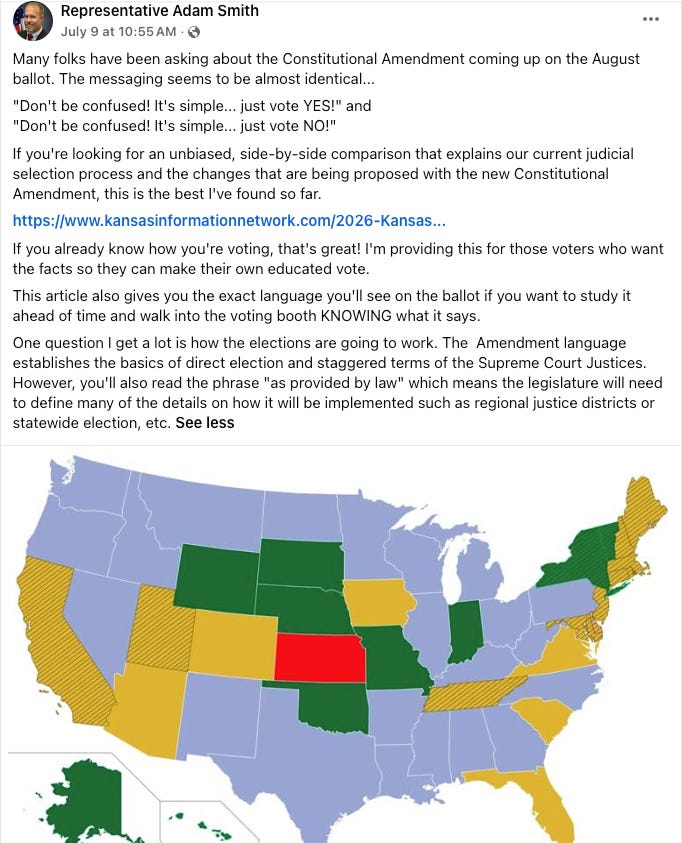
This site, however, isn’t unbiased at all - and neither are the people who started it.
The first hint of bias comes from the home page, which paints Kansas in dramatic red - an effort to highlight that Kansas stands alone in the way it selects justices with its “Bar Controlled” method.
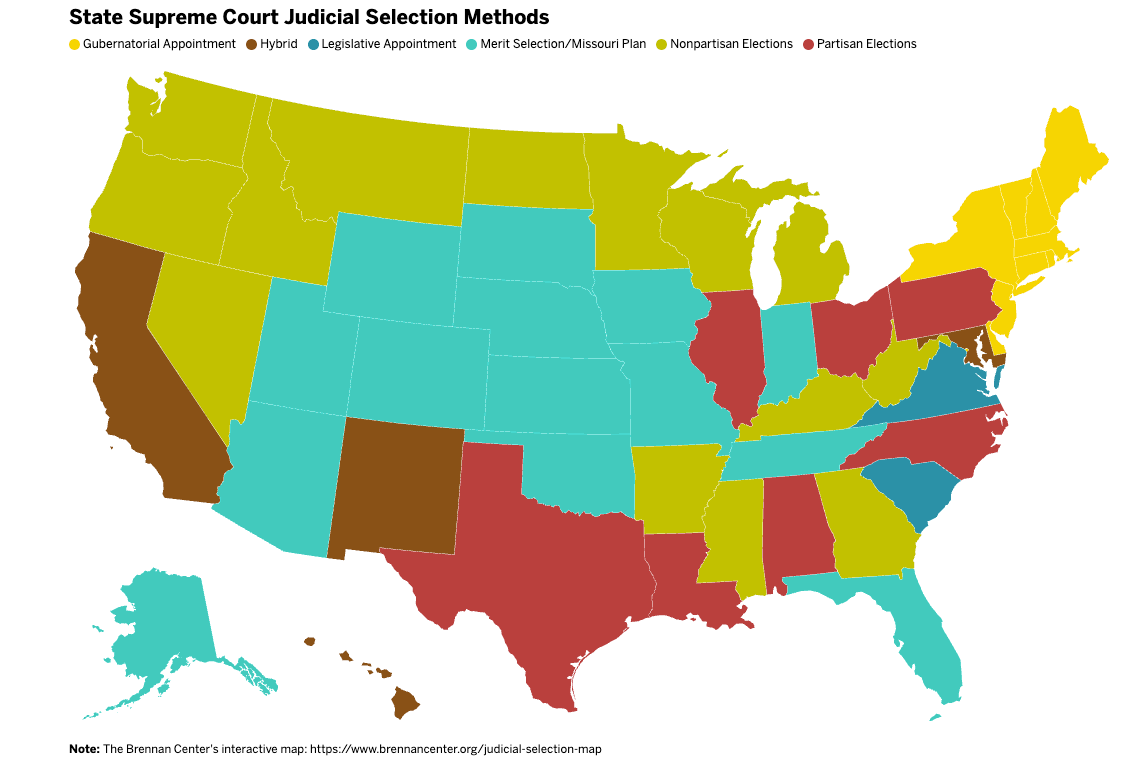
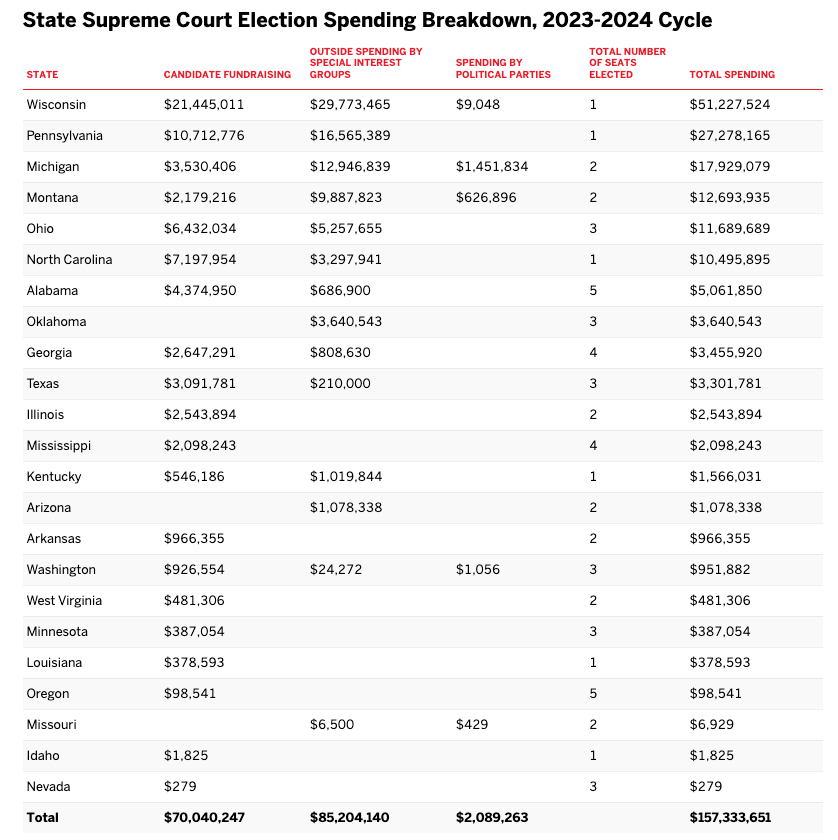
Less biased maps can be found at State Court Report, a project of the Brennan Center for Justice. This map reveals that partisan elections of Supreme Court justices - as proposed under the proposed amendment is among the least favored method in the U.S. Kansas falls under a merit selection process, which is used in 14 states. Non-partisan elections are used in 14 states, 4 states use a hybrid model, 9 states rely on a Governor’s appointment, 2 states rely on legislative appointment and 7 states rely on partisan elections.
Kansas is hardly an island of Judicial misfit toys.
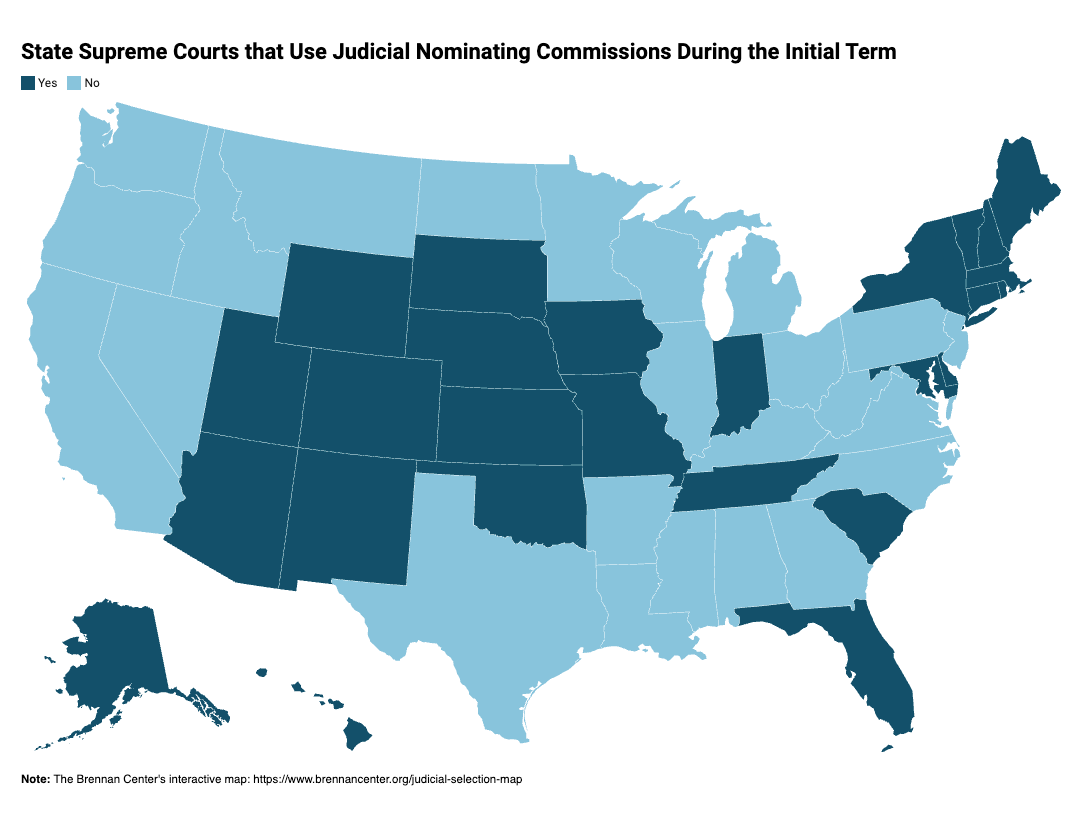
Additionally, the Kansas Information Network site omits that Kansas is among 24 states that rely on a judicial nominating committee to select Justices in their initial term, and in a group of 19 states that allow consistent retention votes after the initial term.
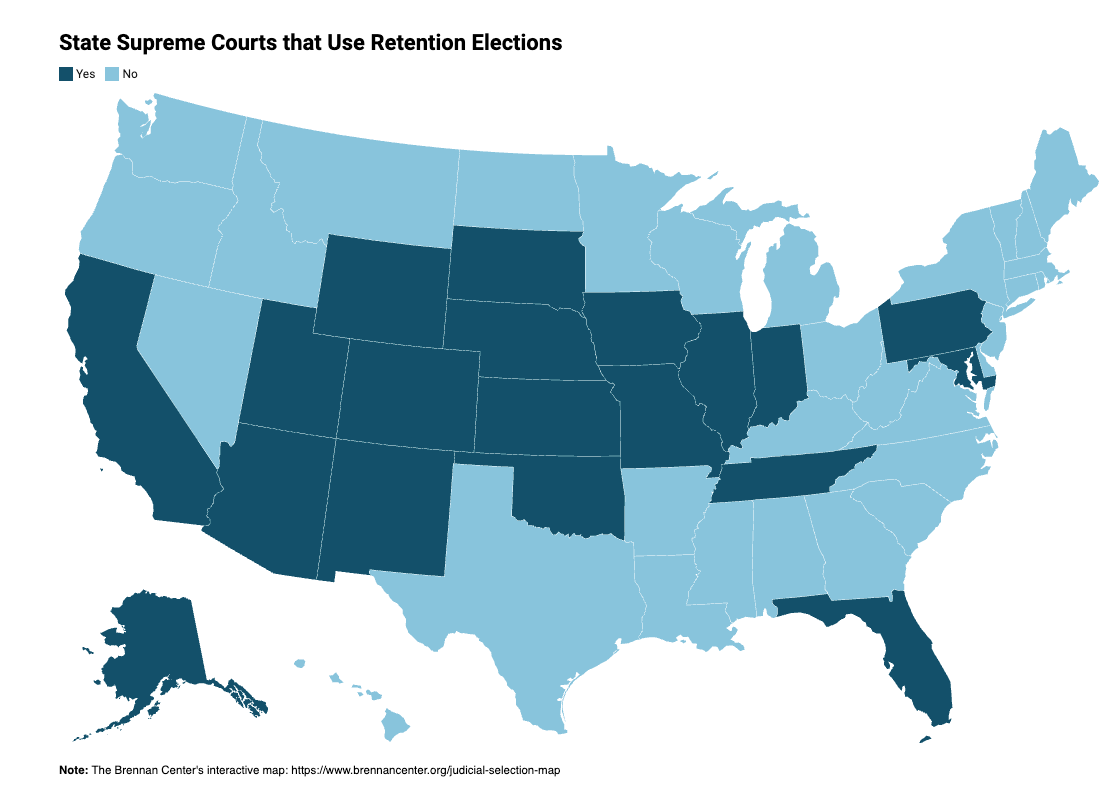
I’d invite you to go to this site and explore for yourself. It’s such good source information, even the Kansas Information Network referenced it, though failed to provide a direct link for its readers.
The narrative on the Kansas Information Network, though framed as neutral and unbiased is anything but. Yet its bias is subtle enough that many people would likely be fooled and take the information as a fair and honest explanation.
The next hint of bias and political skullduggery is that there is absolutely zero information on the site about who is responsible for its creation, financing, or management.
It costs money to be a consistent top search result. People and groups aren’t generally in the habit of spending money to show up in search engines out of the goodness of their hearts. It’s an investment, and someone is hoping to get something in return
In the case of this vote, I’d reckon it’s the right to have some influence over who gets to sit on the bench of the Kansas Supreme Court - ideally someone who is more likely to see the world their way, and maybe pretty keen on the newfound world of dark money that will surely make its way to the election of Supreme Court Justices.
I mean, it’s not like billionaires have ever tried to buy themselves a Justice before.
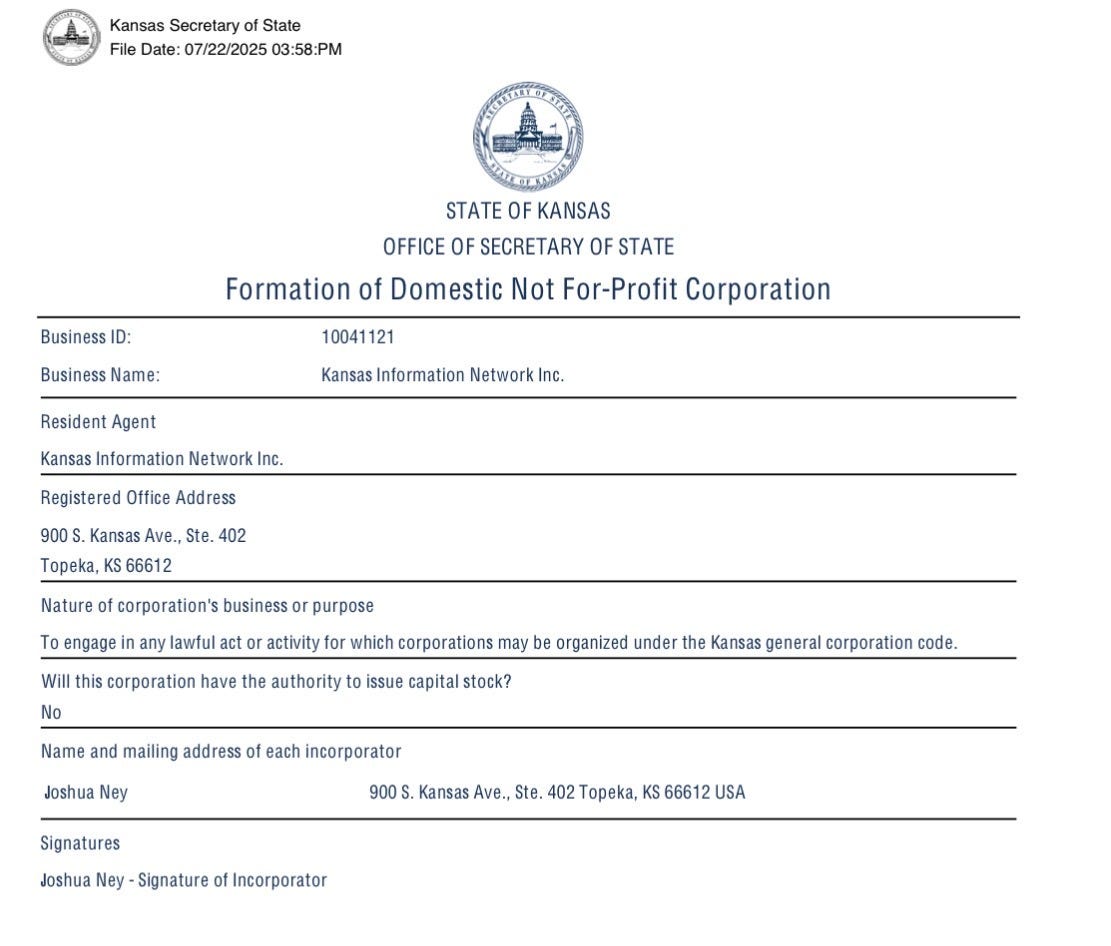
Look up the Kansas Information Network, and you’ll see that the person who incorporated it is Josh Ney. The name might not mean much to most Kansans, but nearly everyone in Kansas politics knows exactly who, and what, he is. Josh Ney is well-known, well-connected, and a very familiar name and face in Republican circles.
Josh Ney is a partner at KN Law Group. The K used to stand for Ryan Krieghauser, who defended Kyler Sweely in the ethics case regarding his residency, filed against him by fellow Republicans. He’s also spouse of Christi Krieghauser, who is VP of Political Affairs for the Kansas Chamber of Commerce, which plays a major role in just about every terrible policy decision that has affected Kansans for the past 20 years.
Ney (and Krieghauser before his appointment as U.S. Attorney) is sort of the go-to attorney for Republicans anytime they get themselves in a pinch. He’s been heavily involved in working to change campaign finance laws in Kansas in a way that allows higher corporation contributions to political action committees, and wiped away many regulations around campaign coordination. He even sought to eliminate the requirement that PACs file ethics reports or register with the state at all by creating an “advocacy” loophole.
Wait. We don’t call it ethics anymore because that hurt some lawmakers feelings.
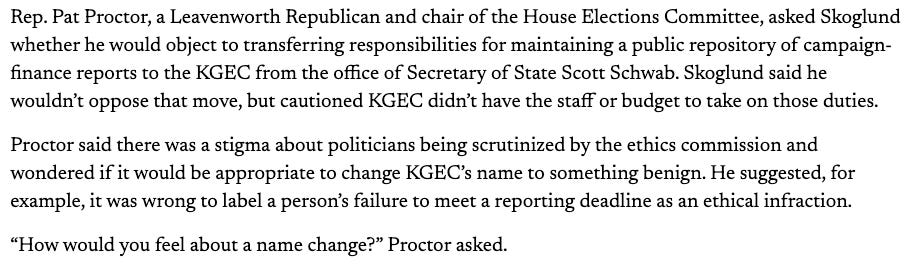
Sure feels pretty woke to me.
On the issue of Judicial selection, Ney offered testimony in support of SCR 1611 - which is the resolution that resulted in the amendment vote on Aug. 4, 2026.
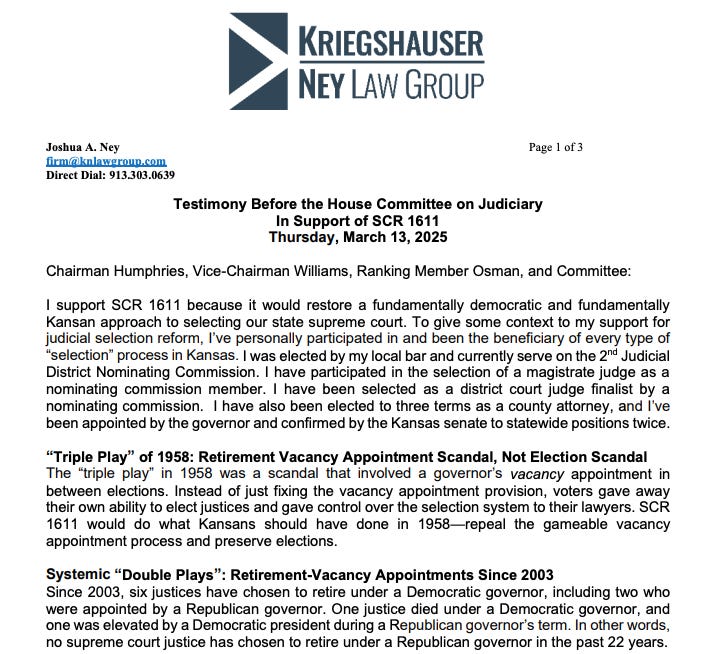
The Kansas Information Network earlier this year booked about $264,000 in ads for what it called a “Right to Vote” campaign.
Ney has a documented bias - which is his to have. Yet he’s formed an information sharing platform that is shielding his very publicly stated positions - and ad buys -behind a mask of neutrality. All while other people who directly supported the Constitutional change are likewise promoting it as fair and neutral.
I think voters ought to ask themselves why. Why would big money groups care so much? Care about you? Do they make these investments to change electoral outcomes for the good of the people of Kansas? Or is there something else at play?
I man, there’s nothing wrong with asking questions, right?
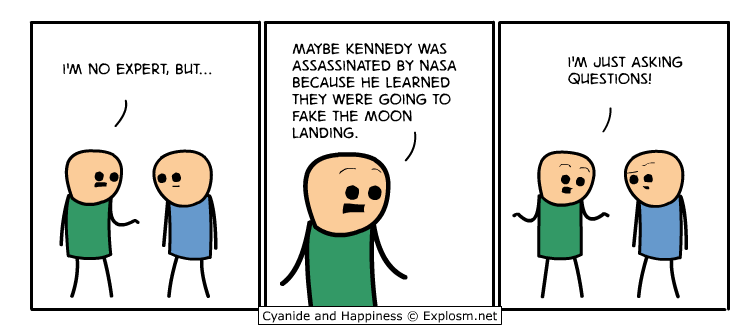
I’ll offer my completely biased - but well informed - hot take.
The truth is that the ruling power in Kansas - and that’s been Republicans for the past 40-plus years - have an iron-clad grip on Kansas government.
They have super majorities in the House and Senate.
They can legislatively do anything they please.
They can override the Governor at will - and sometimes brag about how easily and often they do it.
They have absolute control.
NOTE: I hope you all remember this when they tell you this election season that they simply couldn’t do any more to help lower or offset property taxes. They 100 percent could - if they really wanted to.
The only thing that checks their unmitigated power of single-party rule is the judiciary - and altering the makeup of the Kansas Supreme Court has been a Republican and corporate fever dream since back when Sam Brownback was governor.
That’s why they’re willing to spend so much money, align so many powerful groups, leverage the whole of Kansas government, and craft biased advertising campaigns disguised as fair, and completely devoid of any politics at all.
I’d ask you to ask yourself why.
But while we’re asking questions here, I have one more I’d like voters to consider.
If our lawmakers and these big power groups care so deeply and passionately about your right to vote on everything that affects our state, why don’t they support with such vigor - and with their money - your right to vote in public referendums or initiatives? After all, the vast majority of states have one or the other, or a mixture of both. Yet, anytime we’ve raised the idea of handing over this power to voters, the people you elect in Topeka, supported by special interests, immediately reject the notion.
My completely biased guess is that the people, groups, organizations, and corporations, who actually run the show in Topeka with their money and influence aren’t really interested in your right to vote on what matters to you - things like legalizing marijuana, lowering property taxes, reforming healthcare.
But they are quite interested in ensuring the Judiciary must exist under the same sort of electoral, partisan, political, and financial control they’ve held over the legislature for a generation or more.
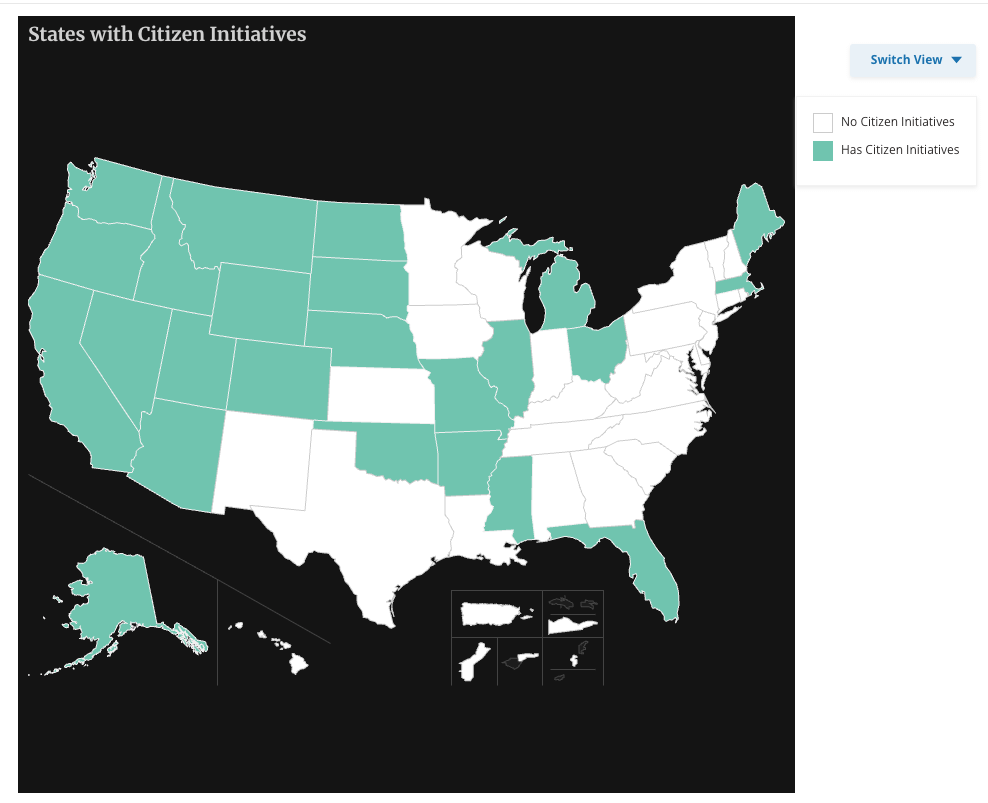
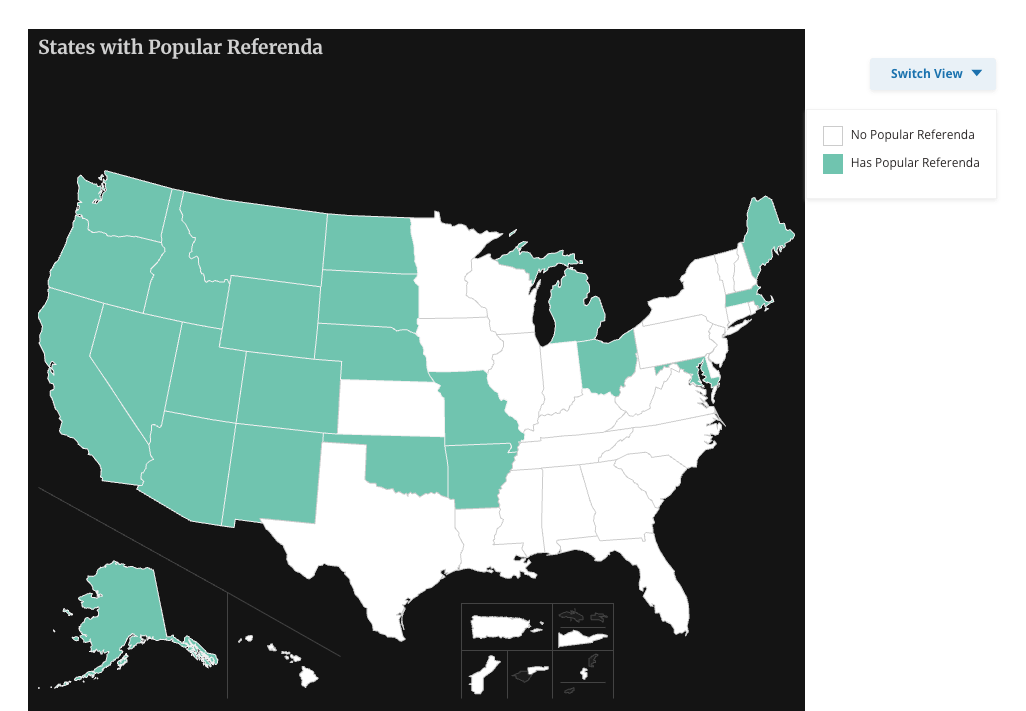
"If our lawmakers and these big power groups care so deeply and passionately about your right to vote on everything that affects our state, why don’t they support with such vigor - and with their money--your right to vote in public referendums or initiatives?"
This is an excellent and on-point question, Jason, and so much smarter, in my opinion, than allowing oneself to get drawn into making this an argument about high, constitutional principles of judicial independence, nonpartisanship, etc., etc. First, because those principles are actually pretty complicated (I feel like there are pretty good historical and theoretical arguments in favor of the election of supreme court justices, though not necessarily conclusive ones), and second, because it's unnecessary. There are SO many ways to show that those pushing this amendment have NO interest in making the judiciary more "democratic," and are completely focused on enabling the election of justices who will overturn Hodes & Nauser v. Kobach. As I wrote in my last column (https://mittelpolitan.substack.com/p/insight-kansas-column-for-july-getting), just acknowledge that this is all about policy priorities; I think making that argument alone will be enough to defeat it, or so I hope.