The Intersection of Big Data, Politics, and You
How this August's judicial vote holds potentially far bigger implications than we imagine

If you’re curious and want to learn more about what you’re being asked to vote on this August, here’s a great opportunity from a group that does great work in the state.
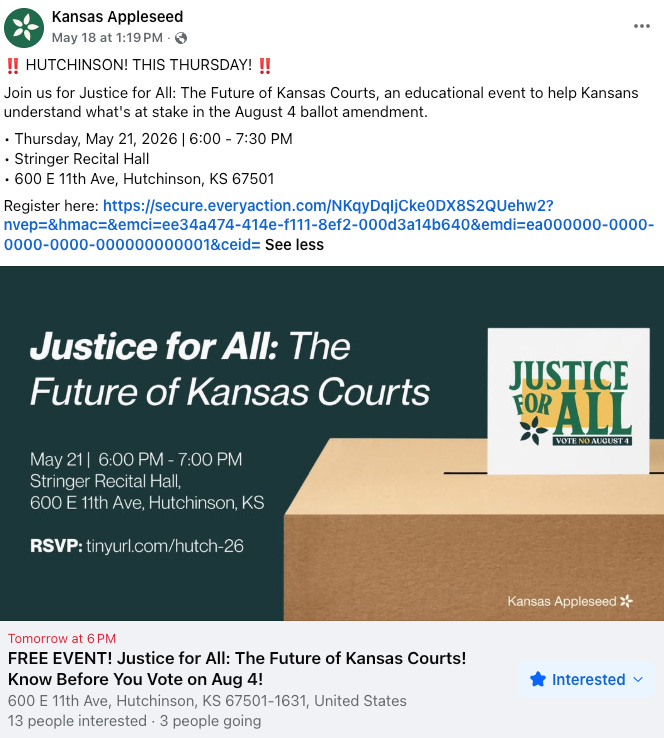
This marketing around this vote is going to be built around the idea of “who could possibly be against elected judges? That’s freedom, democracy, and America all wrapped together.”
But that doesn’t provide any context.
First you have to know about a famous scandal called the Kansas Triple Play - which angered so many Kansans they demanded in 1956 the system we still use today.
Fred Hall served two terms as Lieutenant Governor of Kansas, but he was wildly unpopular with the Republican party bosses. Yet, the party still begrudgingly gave him the nomination for Governor in 1954, because winning is everything, don’t you know.
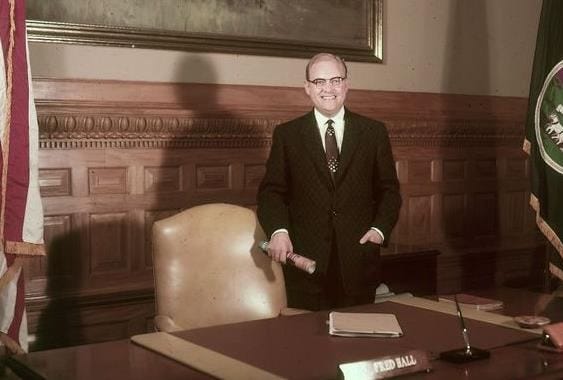
Hall won the election in 1954 and took his seat as Governor. But by 1956 it was clear that the party had abandoned him and he became the only sitting governor to ever lose his party’s primary for re-election as Governor.
So Hall is a lame duck, with a party that dislikes him, and a short amount of time to figure out his next career move. Here’s a summary of what became known as the Kansas Triple Play:
“His next move was a conspiracy that was both sleazy and genius. Fred Hall had no plans to move back to Dodge City as a loser, as a one-term governor. He concocted the only judicial scandal in Kansas history. It even has a cool name: the Triple Play.
In addition to Hall, there were two other actors in the Triple Play. First, there was the chief justice of the Kansas Supreme Court, William Smith, a long time Republican party stalwart. Remember, Kansas was electing judges back then.
How long had Smith been a player in GOP politics? Remember the Archiver episode on John Brinkley, the goat gland doctors who ran a write-in campaign for governor in 1930? Well, many believed Brinkley might have won had not so many ballots been disallowed. The man in charge of deciding which ballots were legal? William Smith, who was state attorney general at the time.
The other player was Lt. Governor John McCuish. He was a newspaperman by trade, he owned the Harvey County Times in his hometown of Newton.
So, here’s the triple play:
On December 31st, 1956, Smith sent a letter to the Secretary of State resigning as Chief Justice. Smith was ill and wanted to resign, but being a good Republican, he didn’t want to quit and let the newly elected Democratic Governor George Docking pick his replacement. Then on January 3, 1957 Hall sent a similar letter, quitting just 11 days before his term ended. McCuish was in the hospital in Newton and Hall dispatched a Highway Patrolman to bring him back to Topeka. McCuish was automatically elevated to Governor and he immediately appointed Hall to the state’s highest court and The Triple Play was done. Hall was on the supreme court where he hoped to launch a future bid for governor.”
Kansans were so appalled by this abuse of power, they demanded that we STOP electing judges and create a better process to ensure our judiciary is selected on merit, experience, and ability - and not on political favoritism.
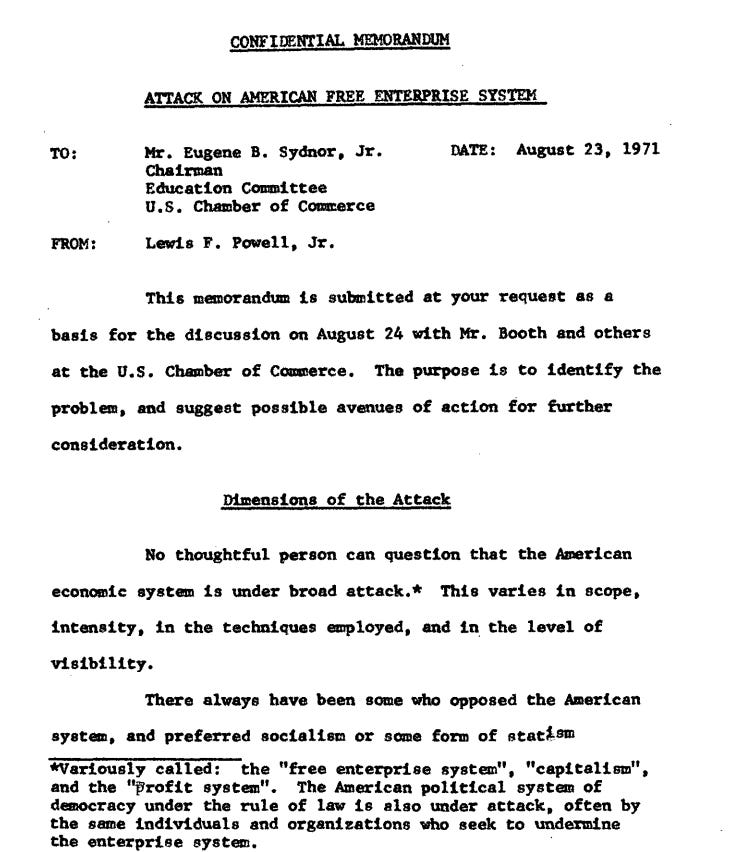
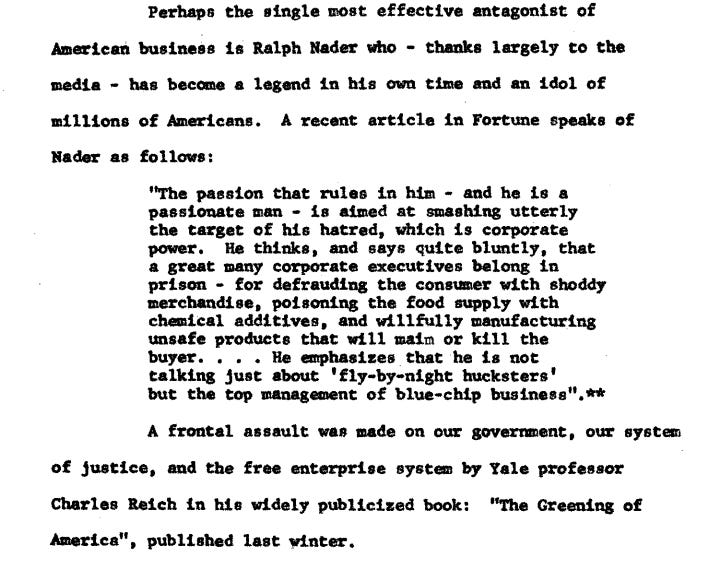
Another point worth making here is how the Corporate world has worked to capture the levers of political power, specifically the courts, and it was all outlined in a memo produced in 1971 by Lewis Powell.
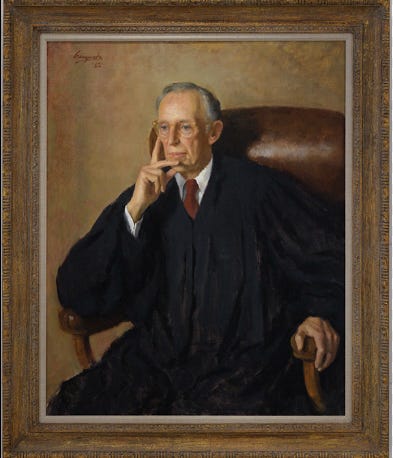
Powell was a corporate attorney and board member for what we now call “Big Tobacco” arguing in court that smoking was harmless. He was later appointed as a Supreme Court Justice - but before taking that seat he wrote to his friends at the U.S. Chamber of Commerce about how important it was for the ruling business elite to pool their resources and energy to capture all the branches of government. He had this to say about the courts: “Under our constitutional system, especially with an activist-minded Supreme Court, the judiciary may be the most important instrument for social, economic, and political change.”
And indeed it is. Because within 48 hours of the Trump-dominated United States Supreme Court striking down key parts of the Voting Rights Act of 1965, Southern states raced to revive Jim Crow laws and redraw maps that disenfranchise black voters. Louisiana even tossed out nearly 45,000 legally cast ballots so they could hold the election under new maps that favor Republican power holders in the state.
It sounds pretty appealing to directly elect Supreme Court justices, but let’s play a scenario closer to home - one that in many ways is already underway and in progress.
Let’s say a city and county located in central Kansas, maybe close to the Arkansas River, are having private, off-the-record conversations with an AI company that wants to build a data center, use that community’s water and electricity, get property tax and sales tax abatements.
Maybe the public catches wind of a development being planned somewhere east of that town, or out in the county somewhere, and people start to demand transparency and protections, even specific zoning and planning laws that would require these companies to protect our resources and be a positive addition and fit for our town.
And the city council/county commission responds to the public outcry! Hooray!
They pass these additional protections and now this company can’t just have its way with these communities. It can’t just use their water, make a bunch of noise, etc., without going through a more public process - thanks to responsive and responsible local government and the actions of an engaged, concerned citizenry.
But wait!
There’s a judicial election coming up, and now that Supreme Court justices can be partisan, elaborate on policy philosophy, and state how they’ll probably rule on cases, the likes of Elon Musk, Kevin O’Leary, Jeff Bezos, and the other billionaires trying to ruin all our lives know exactly where to make their “investments.”
(An aside: If you want to have a good laugh and be horrified all at once, watch this video. Kevin O’Learly accused these two women who publicized his proposed data center of being “Chinese Operatives.” They are not. But they’ve made some great videos highlighting so many connections to powerful people and policymakers.)
Remember that Musk spent upwards of $25 million to try and buy a judge in Wisconsin in what became the most expensive judicial election in American History at $90 million. The election of judges and justices have helped sow doubt about the independence of our judiciary across the country - and has led to dramatic increases in judicial campaign spending over the years.
So back to our little town by the river with our new, cute little ordinances designed to ensure the people who live there will still be able to live and thrive if a giant AI data center comes to their town.
During the campaign season, however, what might happen if the richest companies in the world decided to invest heavily in supporting the Supreme Court justices of their choosing?
What if they threw millions upon millions of dollars trying to convince the body politic that the same Supreme Court justices that are good for billionaires are also good for the everyday citizen of our Central Kansas City by the River?
History tells us they’ll likely be successful and the election will go their way.
Then I expect they would file a number of legal cases arguing our efforts at protections violate the Kansas Constitution, and they’d quickly run the case up to the Highest Court - where their newly seated justices sit.
And since we have new competitive, partisan elections for these positions, it’s also quite likely that during their deliberations, those justices are likely to remember who brought them to the dance in the first place, what outsized influence that money had in the election - and whose support they’ll need in the next election cycle.
So the justices strike down our quaint city’s codes and protections, or uphold some state law that says local ordinances restricting business is not allowed - ensuring unfettered access and freedom to build as many data centers, in as many other quaint little prairie cities as they please - all without the concern of even a hint of regulation, responsibility, or commitment to any of those communities.
The motivation behind the Republican supermajority pushing for this change isn’t based on data centers - it’s rooted in frustration with rulings on education funding and reproductive care.
But I can’t tell you how many times I’ve watched monied interests leverage social concerns - which corporations don’t care about at all - to secure policy wins on taxes, regulations, and to get themselves some nice big taxpayer-funded welfare.
Generally speaking, the Kansas Legislature is filled with followers who will do as they’re told, so instead of writing smarter, cleaner laws, or directing state resources in a way that is constitutional, the Kansas Legislature has decided it’s easier and less effort to just buy up the courts.
In addition to all the other problematic doors that will be opened if we move to a partisan system for Supreme Court justices, we will 100-percent be inviting billionaire control of our judicial system.
And they will use that control to invalidate any local level laws that get in the way of their mission, which is clear and simple: Extract as much wealth from every person, everywhere, until there’s nothing left to take all.
The connection between this upcoming judicial election process and the growing debate and discussion of community protections around data centers doesn’t yet exist.
But it will. If we allow it.