
20 Questions about Data Centers
Answers our community should demand before agreeing to any economic development

I have to hand it to the local folks championing the growth of data centers in or around Hutchinson and Reno County - they figured out that one of the fastest ways to get a bunch of men to stop thinking is to simply accuse them of being “weak.”
Calling a man weak generally gets up his dander and makes him see red. That might explain why the lone woman on the council has seemed to understand the gravity of the moment we’re in, and been trying to pump the brakes.
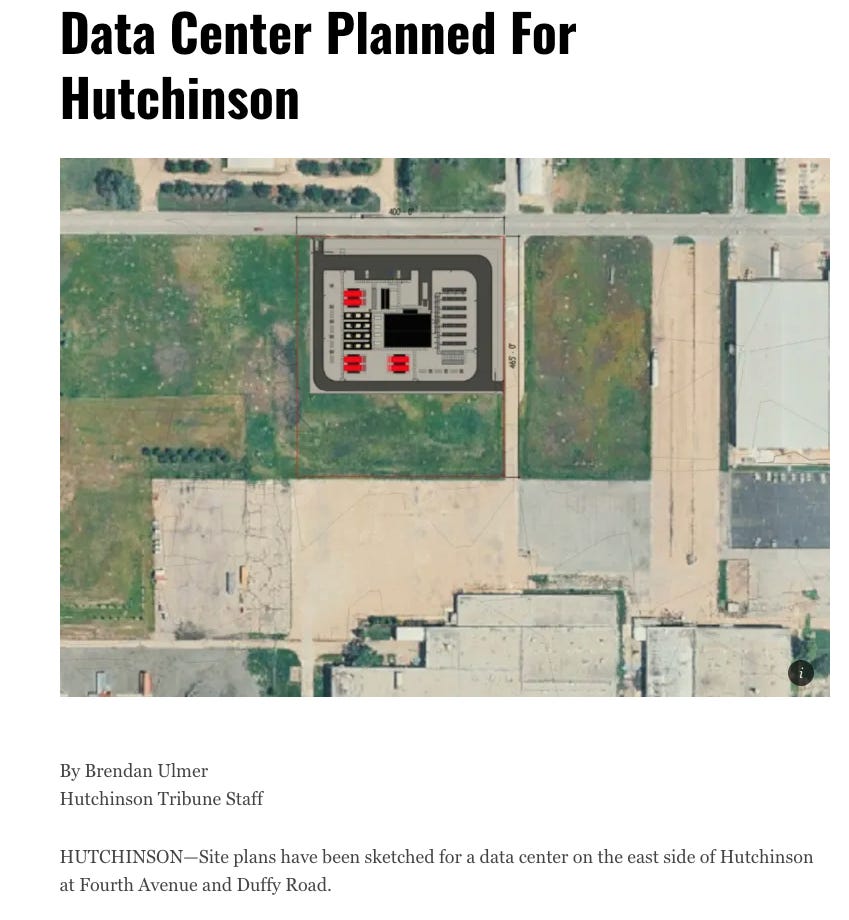
Now, thanks to the reporting of the Hutchinson Tribune, we have it on record that there’s a plan for a smaller scale data center east of town, on 4th and Duffy Road.
Weirdly, or maybe not so weirdly in this world, the conversation around data centers appears to be developing an undercurrent of partisan politics, with a splash of international political espionage.
The Trump administration is a full-throated supporter of building more data centers across the country. Together with billionaire investors like Kevin O’Leary (from SharkTank) they’re creating a narrative that there’s not real life opposition to data centers, just Chinese operatives and leftist agitators. I even saw a report today that the CIA, FBI, and DHS are launching online surveillance efforts at what they describe as “Anti-Technology Extremism.”
That narrative falls apart, though, when we examine the local level.
There has been a lot of emerging activism about the possibility of a data center around here, and that opposition runs across the political spectrum. Folks who agree on very little else are finding common ground on this issue.
I genuinely hope we’re on the cusp of realizing that it never really was a left vs right fight - it’s always been a uber-wealthy vs the rest of us fight. For as long as there have been people, there have been other people who work to keep us all fighting against one another so they can reap the spoils. No group in history has done that better than the billionaire class today - and with the technology they now own, they’ve perfected the art of social manipulation and media exploitation.
But I digress.
I am generally against the development of data centers without explicit consent from the public. I retain the possibility that my mind could be changed, and I’d become more accepting of data centers - but for that to happen, there are a list of questions I think we all deserve to haven answered - clearly and plainly - before we subject our community to the potential coming onslaught of our digital and billionaire overlords.
The logic I apply to data centers is the same I apply to any economic development project: Does this project add tangible value to our community, or does this investment extract resources from this community without providing anything in return? Especially if said development is asking the public to pony up - which they almost always do. If the public is being asked to invest, it is reasonable to ask what the return on that investment might be - just like any good businessperson would do.
Today the conversation is about data centers, but this is a familiar pitch we know quite well.
We’ve been sold economic development pipe dreams before. The promised boom of related suppliers around the Siemens plant never took off. Eaton took its taxpayer money and then cruelly forced soon-to-be unemployed workers to train their replacements at the shiny new plant in Mexico. Over the years, we’ve celebrated “wins” that are just on the horizon, only to watch them disintegrate before they ever got started.
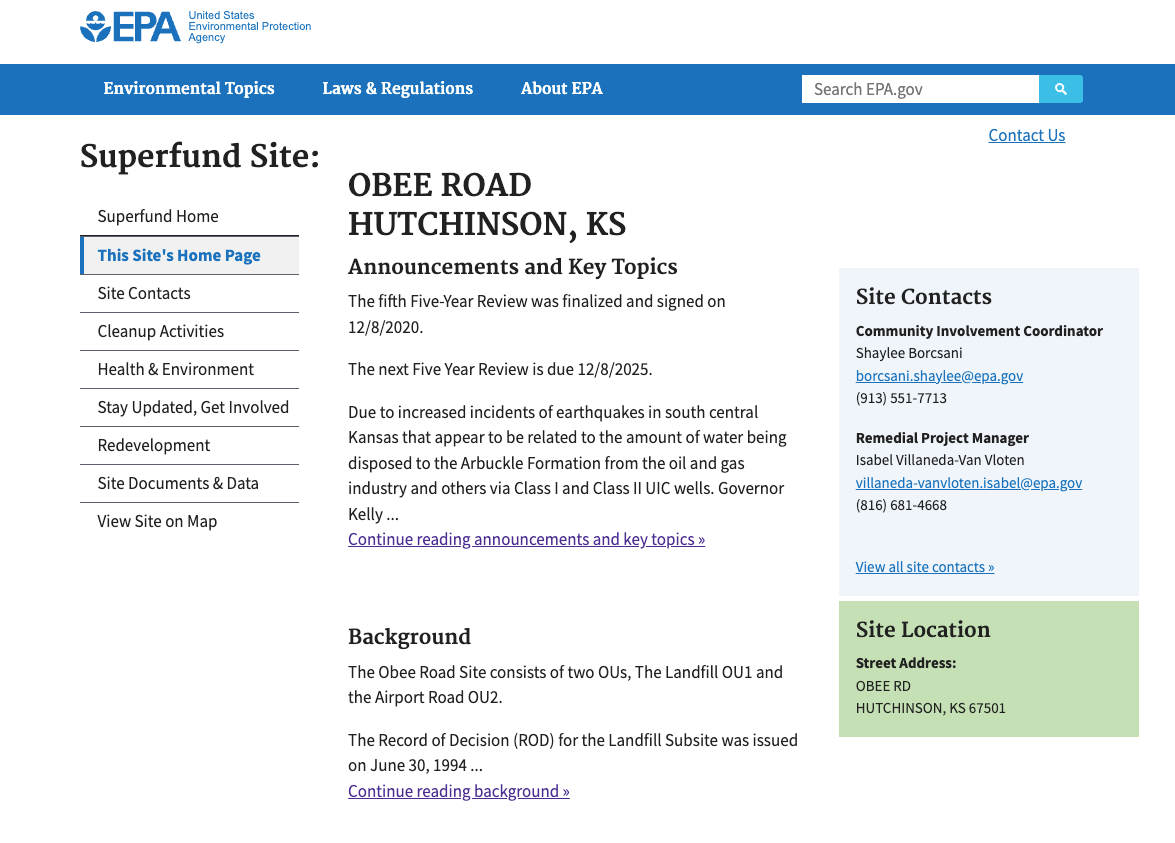
And for years, we’ve been dealing with the fallout from industries that irresponsibly polluted and mistreated our community. The industrial area east and south of the Hutchinson Mall was heavily polluted and there’s an EPA Superfund Site east of town due to years of solvent and chemical pollution. In addition to making parts of our community functionally useless, such abuses also increase the burden on local and state taxpayers. In fact, the city has spent roughly $200,000 a year for decades to maintain water testing wells due to pollution that happened in the 1970s and 80s.
Locally, we’ve been told that any restriction on data centers would be “weak.”
Well, color me stupid, but I think it’s even weaker to stand flat footed and not defend yourself against the blows you can see coming - especially against the gazillionaires who own the world’s technology companies and have nearly all the world’s wealth.
The argument that we have no agency, no right to self determination to create policy that protects the long term interests of our community is absurdly vapid. No one is going to save us, and no one is going to look out for our best interests in the same way that we will.
I’m no Luddite - which I guess is the new-old insult we are throwing out at anyone who dares question the benevolence of our digital overlords. I have often been an early adopter of technology and am always curious about how it might improve my work or life. But I’m also skeptical of people who sell me a bill of goods without being authentic about the downsides. I’ve been around long enough to know that money is always the ultimate goal in these sort of deals - and historically the love of money leads people to compromise communities, relationships, health, wellbeing, and the environment.
Regardless of whether you lean for or against these data centers, or haven’t made up your mind, I’ve compiled a list of questions I think are worth the asking - for Hutchinson and any community.
How much water will the proposed data center use? And I need specifics - not “just about the same amount as an average Reno County farm.” Gallons per day, and where it’s coming from. I want to know how that will affect Hutchinson water, or water in our rural water districts, and private wells. We deserve to know where the water comes from, how it’s handled, and what’s done with it when you’re done with it. We don’t need another company pumping bad water into the Arbuckle formation and reawakening the Reno County fault that caused so many earthquakes several years ago.
How will this data center affect electricity generation and delivery in Hutchinson and Reno County? Will homes suddenly have large transmission lines in their front yards? Will there be an effect on residential and commercial users?
What can we expect in terms of noise, light, and emissions pollutions? How will neighbors be affected by an “always-on” high capacity data processing center?
How will existing neighborhoods around the proposed site be held harmless? There are people there who have owned their homes for years, or recently built. What has been the affect on property values and quality of life for residents near other data centers? Is there a method to compensate them for their real property loss?
Who will own and operate the center, and who benefits or profits from its construction?
Will this data center benefit from SB98, which exempts data centers from state and local sales tax on the initial construction and all updates for the next 25 years?
Will this data center apply for additional state incentives? County, city, and other local incentives?
What’s will be the total public investment into this private, for-profit venture?
Will this data center pay local property taxes, or are they going to ask for abatements? Will any offset payments be one-time offers, or ongoing payments that could offer long-term relief to local taxpayers?
Will construction jobs be local, or does this company bring in its own construction crews for the build-up?
How many permanent employees will be employed by the data center in Reno County?
Will there be a cost/benefit analysis done to determine the net good for the community? Will we be able to weigh how much public investment is used for this project against how much economic, employment, and tax benefit will be created for our community?
Will there be claw back provisions if requirements aren’t met, or regulations disregarded? How will those be enforced?
Do local governments have the ability and resources to litigate disputes or violations against larger, wealthier corporations if they don’t comply with local laws or challenge our legal zoning rules?
From the Detroit News, about one township’s legal fight against an AI data center:
Saline data center sparked statewide outcry
The Saline Township data center project was controversial from the start. Township officials didn’t want it and denied a conditional rezoning request in September. Related Digital sued two days later, arguing the township used exclusionary zoning to prevent the sprawling tech development.
The township stopped fighting. Losing would have been too expensive to justify and “a hindrance on each resident here in this township,” township clerk Kelly Marion said in May.
Instead, the township settled. It agreed to rezone the property, while Related Digital promised to put $2 million into a farmland preservation trust, $2 million into a community investment fund, $8 million into local fire department budgets, preserve 200 acres of farmland, not to expand the data center, not to build solar arrays, to use water-efficient cooling methods and more.
What do we know about the company that plans to come here? Is it connected to a tech giant? Do they have a history of being good community partners, or do they have a history of legal issues or violation of local codes?
What happens when this data center closes or becomes obsolete? Just like previous complains about decommissioned wind turbines, these facilities have lifecycles. Computing power will improve over time, and the foot print of data centers will likely shrink in coming years. Who is responsible for decommissioning, cleanup, and remediation when they’re done?
What data will actually be stored here, and who has legal access to it? If there’s a national security conversation happening at the federal level around data centers, Flock cameras, etc, and residents deserve to know what’s sitting in their backyard and under what legal authority it can be accessed.
What is this company’s track record at other facilities? Not the press release. What do residents near their other data centers actually say about water, noise, property values, and whether promises were kept?
Who negotiated this deal, and how much of that conversation happened outside public view? When did this actually start? Executive sessions and letters of intent have a way of producing facts on the ground before the public ever gets a seat at the table. What mechanisms and opportunities exist for the broader public to engage?
If AI and data centers are so profitable, transformative, and inevitable, why is the public being asked to fund incentives to support them?
This passage does a great job of explaining something that I've had trouble articulating to others:
"I have often been an early adopter of technology and am always curious about how it might improve my work or life. But I’m also skeptical of people who sell me a bill of goods without being authentic about the downsides. I’ve been around long enough to know that money is always the ultimate goal in these sort of deals - and historically the love of money leads people to compromise communities, relationships, health, wellbeing, and the environment."
Combine this skepticism with Question 20 and I think you'll find that the wealthy companies fronting the installation want to pay and give back to the community as little as possible. Unless there's a viable, long-term positive impact on a local economy and/or its people, it makes no sense to invest tax dollars on a project like this.
Nice job putting this list together JP!
Good job Jason. Here's my view. I feel like the Vikings have arrived to pillage. https://danielnagengast.substack.com/p/we-are-just-here-for-the-pillage?r=mwiwx&utm_campaign=post-expanded-share&utm_medium=web